
At first glance, the Bible on self defense seems to pull in two opposite directions. Jesus tells His followers to turn the other cheek. Old Testament law lets a homeowner strike a thief who breaks into the house at night. Paul preached nonretaliation, then accepted an armed Roman escort when forty men swore to assassinate him. So what does the Bible say about self defense, when all those verses sit on the same shelf?
The answer is less complicated than the surface tension suggests. Scripture draws clean lines between personal revenge and the protection of innocent life, between violence as a default and violence as a last resort, between defending bruised pride and defending the people God placed in your care. Once those distinctions land, the whole topic clears up. This article walks through the central passages, the cultural background behind them, and where careful readers of the whole Bible tend to settle.
What Does the Bible Say About Self Defense in Plain Terms?
Here is the short version. Scripture affirms the right, and in many cases the responsibility, to defend yourself, your family, and the vulnerable from a violent attacker. It also forbids personal revenge, hatred, and aggression. Both of those truths sit together without contradiction once you read them in context. The Bible never confuses defense with vengeance, and it never asks believers to hand over the innocent to violent men.
That is the headline. The longer version, traced through Exodus, the Gospels, Nehemiah, and Paul’s letters, is consistent across the whole canon.
Exodus 22 and the Right to Defend Your Home
The most direct passage on self defense in the Old Testament is written into the Law itself.
Exodus 22:2 (ESV)
The Law explicitly protects a homeowner who defends his life and property at night, when intentions are unclear and the threat is real. The very next verse adjusts the standard for daylight, when the danger is more visible and the homeowner has time to assess. That balance is the key. Scripture is not handing out a license to kill. It is recognizing that a person under attack has the right to act decisively. You can read the full Exodus 22 passage in context here.

“Turn the Other Cheek” Was Never About Real Danger
Many believers stop at Matthew 5 and conclude that Jesus forbade every form of force. The verse deserves a careful second reading.
Matthew 5:39 (ESV)
The cultural context shifts the meaning. A strike on the right cheek with the right hand was a backhanded slap, the standard insult of the day, not a physical assault. Jesus was confronting the human reflex to repay an insult with another insult, not commanding believers to stand frozen while their family is attacked. He was teaching disciples to stop turning personal offenses into endless feuds. He was not instructing a father to do nothing while a stranger threatens his children.
Reading the verse as a blanket rule against all defense forces it to contradict the rest of Scripture, including Jesus’ own words later in the same Gospel and in Luke.
Jesus, Swords, and the Luke 22 Moment Most People Miss
This is the passage many sermons leave out.
Luke 22:36 (ESV)
Jesus instructed His disciples to arm themselves before sending them into a hostile world. When they produced two swords, He said, “It is enough,” signaling the weapons were never meant to start a war. They were meant for protection. Later in the same chapter, when Peter swung his sword and cut off the high priest’s servant’s ear, Jesus rebuked the misuse, not the principle. Peter used the blade for offense in the wrong moment. That is a different matter than defending an innocent person from a violent attacker.
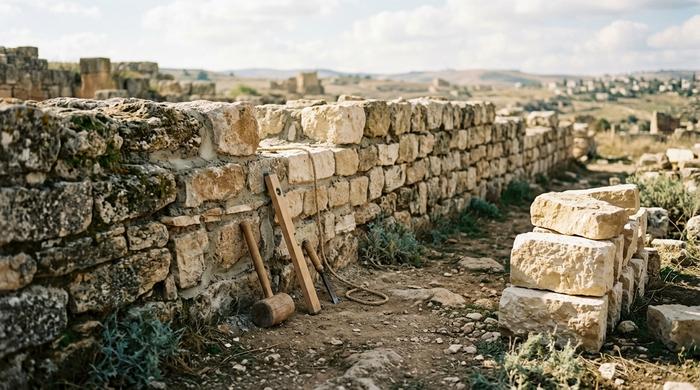
Nehemiah Built With a Tool in One Hand and a Weapon in the Other
The rebuilding of Jerusalem’s walls is one of the clearest pictures of practical readiness in Scripture.
Nehemiah 4:17 (ESV)
Nehemiah trusted God to protect the city. He also armed every worker. Faith and prudent defense are not opposites in the Bible. They are built into the same wall, brick by brick.
The Difference Between Defense and Revenge
This is the heart of the matter. The Bible forbids revenge, and it does so clearly.
Romans 12:19 (ESV)
Vengeance belongs to God, not to you. That is a settled question. But defending yourself, your spouse, your children, or a stranger from harm is not revenge. It is protection. Romans 13 specifically hands the authority to bear the sword to civil government for the restraint of evil. The same principle behind that authority, the protection of the innocent, is what explains why a parent can step between a child and danger without violating Scripture.
The line is intent. Revenge looks backward at a wound. Defense looks straight ahead at a threat.
What the Apostles Did When Their Lives Were Threatened
The early church gives us a window into how this was actually practiced.
- Paul allowed Roman soldiers to escort him under heavy armed guard when he learned forty men had taken an oath to murder him (Acts 23). He did not refuse the protection in the name of faith.
- The disciples hid in a locked upper room when their lives were in immediate danger after the resurrection. Wisdom included strategic evasion.
- Jesus Himself slipped through hostile crowds that were trying to throw Him off a cliff and stone Him, walking right past His enemies until His appointed hour came.
The pattern stays consistent. The apostles never sought conflict. They also never refused to live wisely when conflict came looking for them.

Where Most Thoughtful Christians Land Today
After reading the full counsel of Scripture, most careful Christians settle into a fairly stable position. Self defense is a moral right, and in the case of those who depend on you, a moral responsibility. It is governed by restraint, prayer, and the law of love. It is not the same as eagerness for violence, and it is not the same as collecting weapons for their own sake. It is the quiet readiness to act if the moment ever comes, paired with a deep hope that it never does.
For more on this question, this biblical breakdown of self defense from Got Questions is a helpful additional resource to read alongside the verses above.
Final Thoughts on Self Defense and Scripture
So, what does the Bible say about self defense? It affirms the right to protect human life, including your own. It forbids the use of that right for hatred or revenge. It honors a faith that prays first, prepares wisely, and acts only when love for others requires it. Scripture does not romanticize violence, and it never asks believers to surrender the innocent to evil. Both truths hold together in a single faithful life.
If you are wrestling with this question, take the long view of the Bible rather than a single verse pulled out of context. Read Exodus 22 next to Matthew 5. Read Luke 22 next to Romans 12. The verses do not contradict each other. They complete each other. Together, they describe a believer who is gentle by default, ready when needed, and never controlled by either fear or fury.